Kaynan Nexus
Live machine monitoring for New Zealand manufacturers, a joint product of Salix Limited and Kaynan Fusion Ltd. Kaynan Fusion connects the machines. Salix builds and runs the software: the portal, the dashboards, the alerts, Ask and the apps.
- Between readings, as standard
- 30 s
- Readings thrown away
- None
- Automated tests on every push
- 616
- Formal models and proofs
- 31
Which machine stopped,
before anyone walks over.
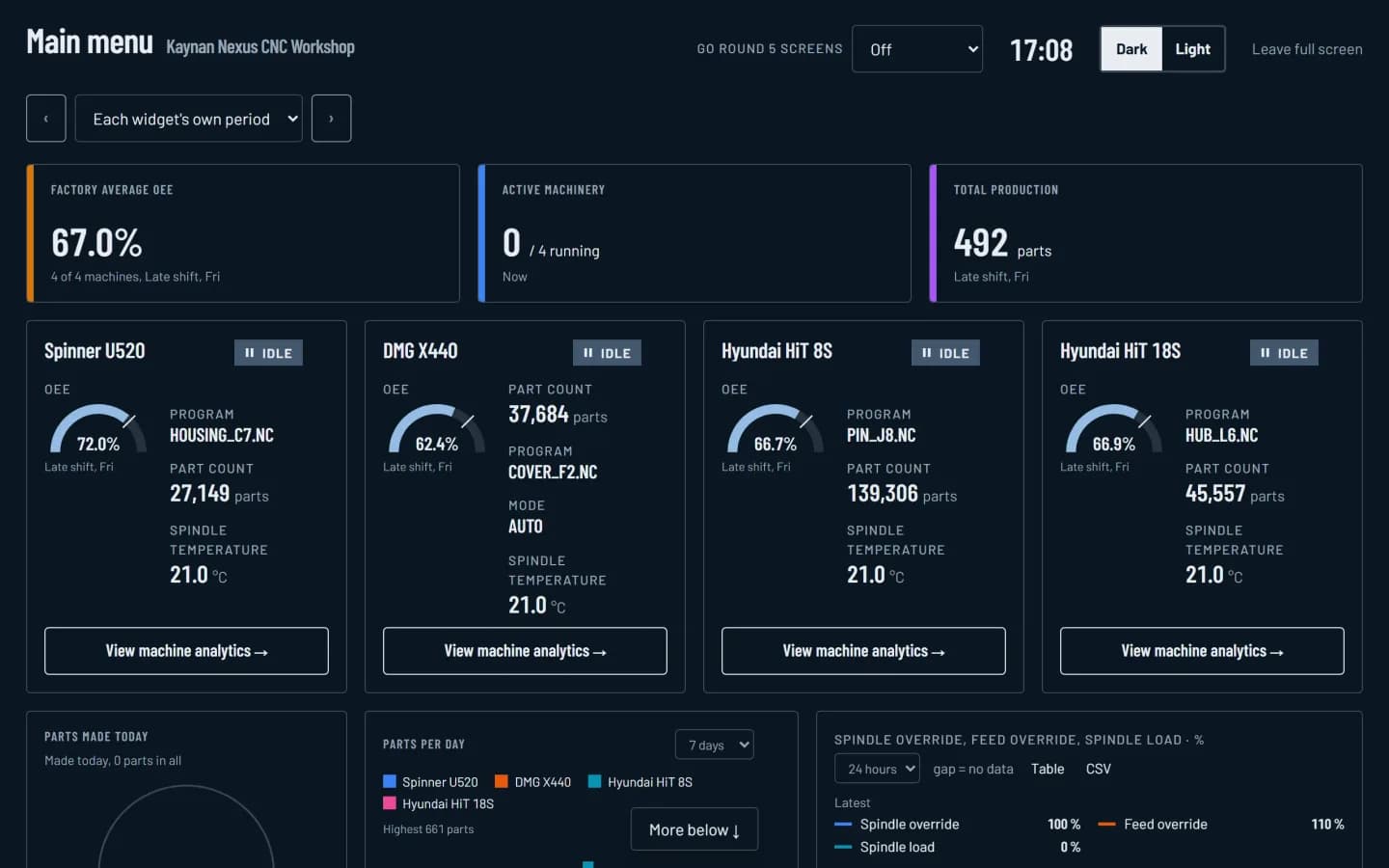
Every machine, and how long it has been that way
Running, stopped, late or not reporting, each with its time in that state. A machine that goes quiet is shown as not reporting, never as stopped, because the two call for different people.
OEE from two signals the machine already has
A run signal and a part count give availability, performance and quality for every shift. Only shift time counts, so a closed weekend is not downtime, and every figure says which shift it covers and whether that shift is still going.
Every stop found, and the reason asked for
Stops are found from the machine itself. Short ones are coded on their own; longer ones wait for the operator to pick a reason on a screen kept at the machine. The day view shows the shift as a timeline, with where the time went at the top.
Screens the plant designs itself
Charts, gauges, tables, counters, and a drawing of the line with live values and lamps on it. One goes on the workshop TV and keeps itself current; another goes to a customer as a read-only link.
The machine’s own alarms, ranked by time lost
Alarm bits become a live list, with the alarms that cost the most time this week at the top, which is usually where the fix is.
History that is kept
Every reading is stored and none is deleted. Older data is compressed and summarised by hour and by day, so a year-long chart opens as quickly as an hour-long one.
Alerts worth
reading.
Evaluated on the server, not in a browser
A closed laptop is not a missed alert. Limits are checked as each reading arrives, and the people who need to know are told by email and on their phones.
Told again when it is over
Every alert is followed by a back-to-normal message, so nobody has to walk over to find out whether it is still happening.
A value on the limit is one alert
A reading can be required to stay out of range for a few minutes before anyone is told, and a value hovering on a limit stays one alert rather than an email every thirty seconds.
A report every morning
Yesterday’s hours, stops and alerts by email for whoever wants them, with a short written summary on top where the company has asked for it.
A question about the floor,
in plain words.
A question, typed or said
In English or Turkish: how many times did this alarm come today, which machine stopped longest this week. The answer comes from the company’s own readings and says what it looked at.
Never in the path of a reading
Ask reads; it changes nothing and nothing waits on it. It is an add-on, switched on per company, and a company that never turns it on loses nothing.
One portal each,
and no way between them.
A portal per company
Its own name, logo and colour, on its own web address if it wants one. Adding a company, an address or a logo is data, not a code change.
No company ever sees another
Every query is scoped by the company in the signed-in session, never by anything in the request. The rule is tested on every push.
Partners see their own customers, and only theirs
An integrator who looks after several plants gets one login that opens each of its customers’ portals as their admin. That access rule is proved for any number of companies and partners, and checked against companies being moved and a forged cookie.
Roles that match a plant
Viewers see machines and alerts. Managers also set limits. Admins also invite and remove people. Everyone signs in with a password or an emailed link.
The same portal,
in a pocket.
On the App Store
Kaynan Nexus for iPhone, with alert notifications that open the alert, an optional Face ID lock and its own offline screen. The Android app is in testing.
The same portal, not a second product
The apps show the portal itself, so a fix reaches every phone without a store update, and nothing differs between the screen on the wall and the one in a pocket.
The part most
case studies leave out.
No outcome figures yet
Nothing has been measured against a before, so no number about downtime saved or OEE gained is printed here. Everything above is what was built and what was checked.
Proved is narrower than it sounds
The proofs and models cover the rules that decide who sees what and how readings are handled when several things happen at once. They show the rules are right, not that the code matches them, which is what the tests are for.