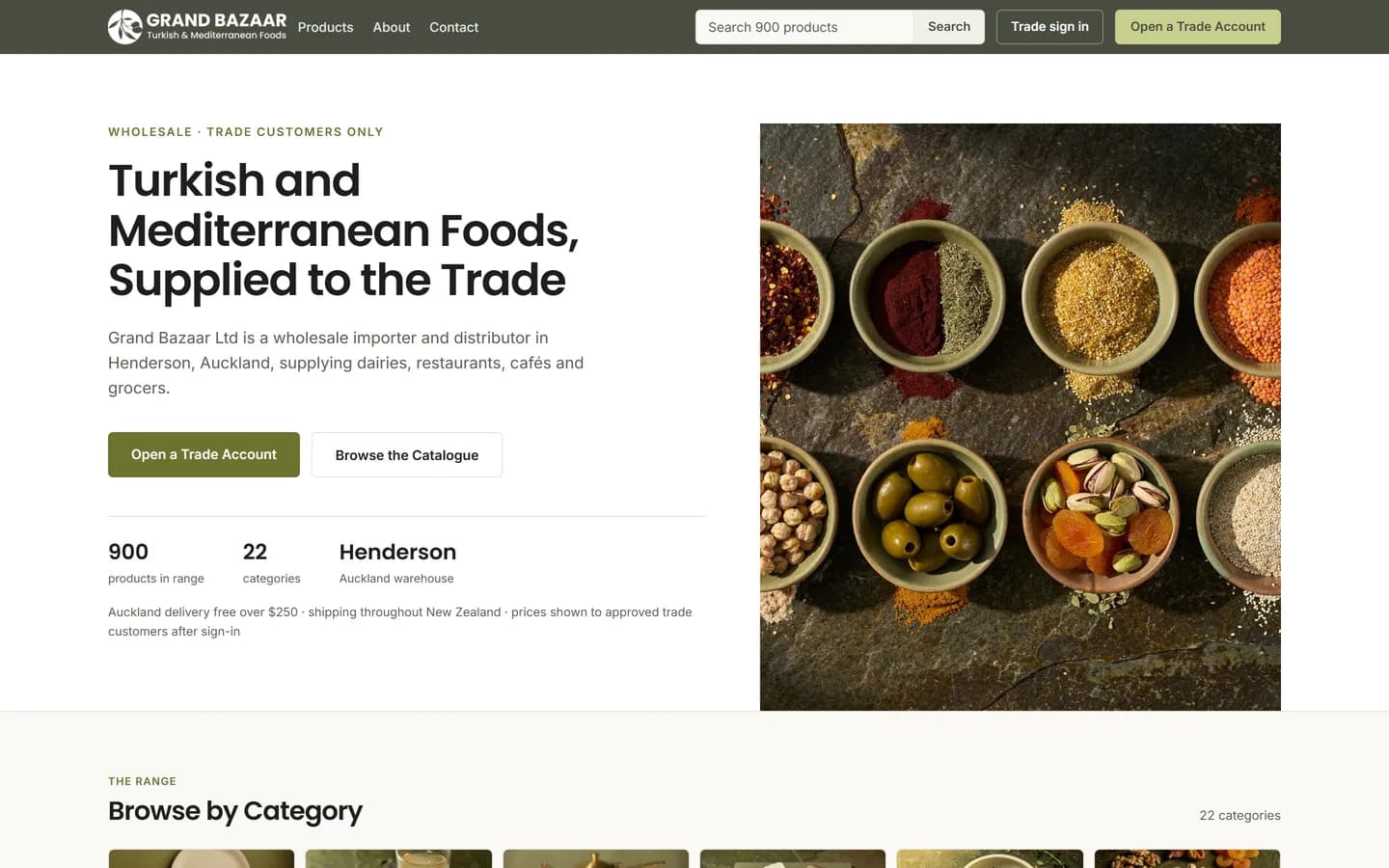
Field guide № 08 — Trade & wholesale distributors

A price list only your approved buyers can see.

Your reps take orders on WhatsApp. Your prices live in a spreadsheet with four customer tiers in it, and the copy on somebody's laptop is not the current one. And the trade site you already have may be one badly-guarded endpoint away from handing your whole wholesale list to a competitor. We build the catalogue, the account-gated ordering portal and the office side behind it — and we make the price leak structurally impossible rather than merely unlikely.

For food and beverage importers, hospitality and building suppliers, packaging and auto-parts distributors across Aotearoa — anyone whose price depends on who is asking.

§ 01 — What we build

The catalogue, the portal
and the office behind it.

A trade portal is an operational system a business takes orders on, not a brochure with a login bolted to the side. These are the four parts, and the first one decides the shape of the other three.

Prices nobody outside the account can read

Not hidden in the page — absent from it. The public catalogue table carries no price column at all, so asking it for a price is a build error rather than an incident, and the schema that does hold prices is not published to the API, so a request for it returns 404 rather than an empty list. An empty list would mean a single policy was the only thing standing there.

An order book, not an enquiry form

The basket is the order, in draft — one per account, not per person, so an owner and a manager at the same customer are placing one delivery rather than two. Minimum order quantities are applied on the server, every amount is recomputed there, and the browser never sends a price. Quantity changes are ordinary form posts, so it still works on the locked-down counter PC that is the machine this is actually for.

Approval you can withdraw in a second

Whether an account may see prices is read from the database on every single query, never stamped into a login token. Suspend a customer and the prices stop on their next request, not in an hour when a token happens to expire. Sign-in is a link sent to an address you already hold, and the form answers identically whether or not that address exists — so nobody can use it to find out who buys from you.

The counter side, for your staff

A queue of live orders with a status machine that refuses illegal moves rather than trusting a button to be disabled, short supply that can only reduce a quantity and only with a reason the buyer is told, dispatch stamped once and never re-stamped, and every move written to an audit log. Over a credit limit flags an order for review; it does not refuse it.

Migration off whatever you have now is part of the build, not an extra line on the invoice. Products, categories and images come across, and the old addresses keep working — a wholesaler's customers have deep links to their regular products saved, and a rebuild that quietly breaks them costs you orders from the people least likely to ring up and complain.

If your catalogue is thin on photographs or descriptions, we will count it and tell you before we design around it, rather than shipping a grid of blank tiles and calling the gap a content task afterwards.

§ 02 — Field record

One portal built,
and it is not named.

This is a single engagement, and the client has not been asked whether we may name them — so it is described by what was built and measured, not by whose logo it carries.

A 559-product trade catalogue, migrated whole

Lifted off a WordPress storefront into a purpose-built system: 559 products, 26 categories, images re-hosted and cut from 107.9 MB to 18.2 MB, and 618 old URLs mapped so nothing a customer had bookmarked or Google had indexed went dark. The source was measured before anything was designed around it — 59% of products had a photograph and 1.4% had any description — so the pages degrade to typography where the content is missing instead of rendering blank frames, and writing what is missing stayed a client task rather than something invented to fill a template.

A price gate proven to close and proven to open

Fifteen automated checks, wired to run on every push and again each night against the deployed site, and a red result stops the release. Half of them prove the gate shuts — the price schema answers 404, an account still under review sees nothing, no money-shaped string appears anywhere in the public HTML, no price identifier survives into the shipped JavaScript. The other half prove it opens, because a policy tight enough to refuse everybody is not security, it is a broken product.

Orders that survive the ways orders actually go wrong

Two tabs pressing Send serialise on a row lock. A resubmitted order is refused by the database rather than by a disabled button. Line prices freeze at the moment of submit, so what a buyer was charged in March does not move because the list changed in April, and GST is computed once on the total rather than per line and summed, because rounding twice produces a number that does not match the invoice. Each of those was verified end to end against fixtures before it was written down.

What is not claimed here is an outcome. One portal is not a sample, nothing has been measured against a before, and any figure we printed about orders won or errors avoided would be invented. What is above is what was built and what was checked.

§ 03 — Packages

Audited first,
quoted second.

One fixed price you can commit to this week, and a band for the build so a purchasing manager knows whether to keep reading. The quote comes out of the audit, not out of a phone call.

salix · ratio

The Ledger

$1,500 NZD

Fixed price, three days, credited in full against the build if you go ahead. No GST: Salix Limited is not GST-registered.

  • Your price list and its tiers, read properly
  • What your current site or system exposes today
  • Product, category and image coverage, counted
  • A written scope and a build estimate you keep
  • Yours whether or not you hire us
Ask about The Ledger
salix · emporium

The Trade Floor

$14,000 – $30,000

NZD, quoted out of The Ledger rather than off this page. No GST: Salix Limited is not GST-registered.

  • Public catalogue with no price data in it at all
  • Account-gated portal, per-account pricing and MOQs
  • Basket, submit, order history and staff order queue
  • Migration from your current site, old URLs preserved
  • The automated price audit, wired into your pipeline
Ask about The Trade Floor
salix · custodia

The Warden

$250 NZD/mo

Platform & security — required for as long as the portal is hosted with us. No GST: Salix Limited is not GST-registered.

  • Hosting, nightly off-site backups, certificate renewals
  • Security patching and dependency updates
  • The price audit run nightly against production
  • A database holding your business and no other
  • A real person on email, not a ticket queue
Ask about The Warden

The order runs audit, then build, then platform. The $1,500 is credited in full against the build, so going ahead costs you nothing extra for having looked first — and the platform fee starts when the portal goes live, not before.

§ 04 — Common questions

Asked by the
person who signs it.

How do I know my prices are actually hidden?

Because hiding them is not what this does. We have seen a trade site hide its prices in the front end and serve the entire wholesale list, unauthenticated, as JSON from an endpoint nobody had thought about — and that is the ordinary way this fails, not an exotic one. A price hidden by the presentation layer is not hidden. So the protection here is four independent layers and three of them sit in the database: the public product table has no price column to leak, the schema that does hold prices is not exposed to the API at all, and the grants are revoked rather than merely filtered by a policy, so a careless future change lands closed instead of open. The fourth is that public pages ship no database key to the browser whatsoever. Then an automated suite tests the output rather than the intent — including crawling every public URL with no cookies and searching the returned HTML for anything money-shaped, which is the check that would have caught the failure described above.

Why is the audit not free, when everyone else scopes for nothing?

Because it is three days of work and it produces something worth having on its own. You get your price tiers read properly, a count of what your catalogue actually contains rather than what you assume it contains, a written note of what your current system exposes today, and a scope and estimate you keep. If you go ahead, the $1,500 comes off the build. If you do not, you still have the document, and an honest “you do not need to replace this yet” is a legitimate result. Free scoping is not free; it is paid for out of the next quote, and it is why the people who offer it can rarely afford to tell you not to buy.

Our price list is a spreadsheet with four customer tiers. Is that a problem?

No — it is the normal starting point, and it is close to the shape the system wants anyway. Price is held per account rather than per product, so a tier is just a set of accounts pointed at the same list, and minimum order quantities live on the same rows. What matters more than the spreadsheet is which system you want to own the numbers from here on. Our strong preference is that your accounting package keeps owning them and the portal reads them, because two places to edit a price is two prices.

What happens when a customer goes over their credit limit?

The order is accepted and flagged for someone to look at. It is not refused. A distributor does not want its website turning away a dairy at 6am over a limit the office would have waved through at nine, and an order you never received is worse than one you have to make a decision about. Where the limit belongs is on your screen, next to the order, before it is picked.

Can it talk to our accounting system?

Yes, and it is scoped and priced as a phase of its own rather than as a checkbox, because this is the part that goes wrong quietly. The rules we hold are that the sync is one-directional — the accounting system owns money and stock, the portal owns the catalogue and the orders in flight — and that an order can never be invoiced twice, which needs more than a retry that hopes for the best. Equally important and more often missed: the website must never refuse an order because the accounting system is unreachable. Orders place and confirm regardless, and the sync failure surfaces on a staff screen instead of in front of a customer.

We run two businesses. Can they share one system?

They can share the code. They will not share a database, and that is not a preference we will trade away on price. Three of the four price protections above are database-level and hold precisely because the database contains one business. Add a second and they degrade into an application-level filter, where one missing line of code hands your prices to a competitor who is also a customer. Two wholesale distributors in one category are rivals in a way two takeaway shops are not, so the blast radius gets worse at exactly the moment the safeguard gets weaker. One business, one database.

How long does it take?

The audit is three days and they are booked before it starts. We are not going to print a build duration on this page, because the honest answer depends on how much of your catalogue has photographs, how many customer tiers you really have as opposed to how many you think you have, and whether the accounting integration is in scope. That is precisely what the three days are for, and the estimate that comes out of them is one you can hold us to.

§ 05 — Contact

Tell us how your
orders arrive today.

We read every enquiry ourselves and reply within two working days. Quick chats, long briefs, half-formed ideas — all welcome.

WhatsApp, phone, a rep with a notebook, an email inbox somebody has to retype — whatever it is, that is the useful starting point, along with how many price tiers you run and roughly how many products are on the list. We will reply with a straight answer on whether The Ledger is worth your $1,500 yet, including if it is not.

Phone
Call or text — you get Vakkas, not a queue.